There’s a comfortable feeling that comes from having a full SEO to-do list. Articles shipped, warnings cleared, links chased, reports sent. It looks like progress, and at the end of the month there’s plenty to point at.
The awkward question is whether any of it changed the CTR. Very often the honest answer is no, because the bulk of the effort went into work that was never going to move the outcome.
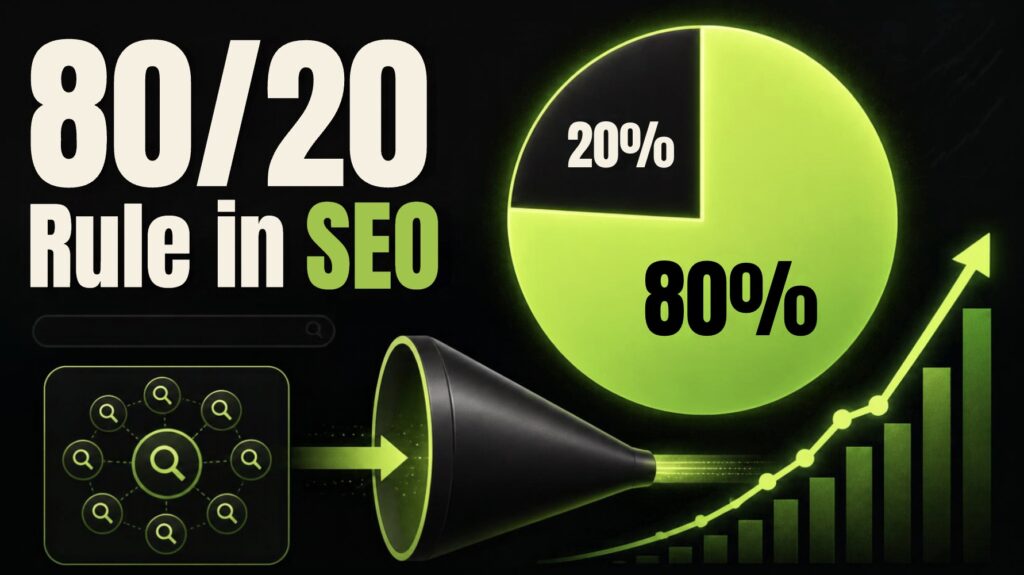
This 80/20 rule is also called the Pareto principle, the observation that a small share of causes tends to produce most of the effects. It’s named after Vilfredo Pareto, the Italian economist who noticed in the 1890s that a fifth of Italy’s population held four-fifths of its land.
On SERP, it shows up as a handful of pages, keywords and fixes carrying almost all of the commercial results, while the rest fills time without paying its way. The skill isn’t doing more. It’s telling the two apart.
What Changed About SEO in 2026?

It is worth being clear about why this bites harder now than a few years ago. Two things changed.
Search results are crowded with years of accumulated content, so a tenth-thin article on a well-covered topic competes against established pages that already earn trust — and usually loses.
And a growing share of searches now end without a click at all, resolved inside an AI Overview or a featured answer, which means raw published volume converts to visits at a worse rate than it once did. Publishing more, in that environment, is often just adding pages nobody indexes, ranks or reads.
The 20% That Pays, And The 80% That Usually Doesn’t
| The 20% worth funding | The 80% that usually isn’t |
| Pages already earning enquiries | New blog posts churned out to hit a schedule |
| Striking-distance pages (positions 11–30) with commercial intent | Vanity keywords that rank but carry no buying intent |
| One site-wide technical fix that indexes a whole section | Cosmetic audit warnings on pages with no search demand |
| A few genuinely relevant editorial links | Bulk irrelevant backlinks bought by the hundred |
Finding Your 20% In An Afternoon
The concentration is usually starker than ‘80/20’ implies. Leading Solution reports that across the SME accounts it manages, the split runs closer to 90/10, with fewer than fifteen pages carrying most of the commercial organic traffic on sites under about 200 pages.
You can find yours quickly: in Google Search Console, open the Pages report for the last twelve months (it holds sixteen, and the interface caps exports at 1,000 rows), sort by clicks, and add a running total until you cross 80% of them. That row number is your 20%.
Then do the step nearly everyone skips: map those pages against actual enquiries, because a blog post with 2,000 views and zero leads is not in your 20%, however healthy the traffic looks.
Your 20% For AI Search Is A Different 20%
Here is the catch for 2026: the pages that earn clicks and the pages cited in AI answers are often not the same. One can rank first and never be quoted; another can sit at position eight and be the source an AI Overview names.
On 3 June 2026, Google added Generative AI performance reports to Search Console, showing which of your URLs surface inside AI Overviews and AI Mode (impressions only for now, and still rolling out).
It matters because the click loss is real: a field study reported by Search Engine Journal found AI Overviews cut organic clicks by around 38% on the queries where they appear. But the brands cited inside the answer capture a disproportionate share of what is left; the traffic does not fall evenly; it concentrates on the named sources. That is Pareto again, in a 2026 outfit.
What To Do With The Other 80%?
The 80% is not worthless; it is over-funded relative to what it returns. Sort every page into one of four actions: keep what still earns and leave it alone; update the striking-distance and decaying pages that have real commercial intent; merge pages cannibalising each other for one query; prune the genuine dead weight with no impressions, links or intent.
One detail that separates people who have done this from people who have only read about it, they always check backlinks before they prune. A dead page with referring domains gets redirected, not deleted.
None of this means doing less SEO. It means refusing to fund the 80% on autopilot. If a Singapore SME is spending somewhere between S$1,500 and S$3,000 a month, that discipline is the difference between a retainer that compounds and one that just recurs. This guide about the breakdown of the 80/20 rule in SEO sets out the full six-step method for finding your 20%, including the striking-distance filter and how to budget a retainer around it.
Start there — then look at what your current SEO spend is actually buying.
Frequently Asked Questions
Where does the 80/20 rule in SEO come from?
It comes from the Pareto principle, named after an Italian economist, who observed in 1896 that about 20% of the population owned about 80% of the land in Italy. The same lopsided split appears in many systems. In SEO it is a rule of thumb for prioritisation, not a precise formula — the real ratio might be 70/30 or 90/10.
Should I delete my low-performing pages?
Not automatically. Sort each underperforming page into keep, update, merge or prune: keep what still earns, update striking-distance pages with commercial intent, merge pages competing for the same query, and prune only genuine dead weight with no impressions, links or intent. One caution — check backlinks before pruning, because a dead page with referring domains should be redirected, not deleted.
Does the 80/20 rule mean I should stop blogging?
No — it means stop blogging on autopilot. For a mature site, improving a handful of existing pages that already earn enquiries usually beats publishing dozens of new posts to hit a schedule. A brand-new site is the exception: it needs to build a base of content and data before any 20% can emerge.
How does AI search change which 20% matters?
The pages that earn clicks and the pages cited in AI answers are often not the same, so you effectively have a second 20% to track. Since 3 June 2026, Google Search Console’s Generative AI performance report shows which of your pages appear inside AI Overviews and AI Mode (impressions only, for now), which lets you measure that second set rather than guess at it.